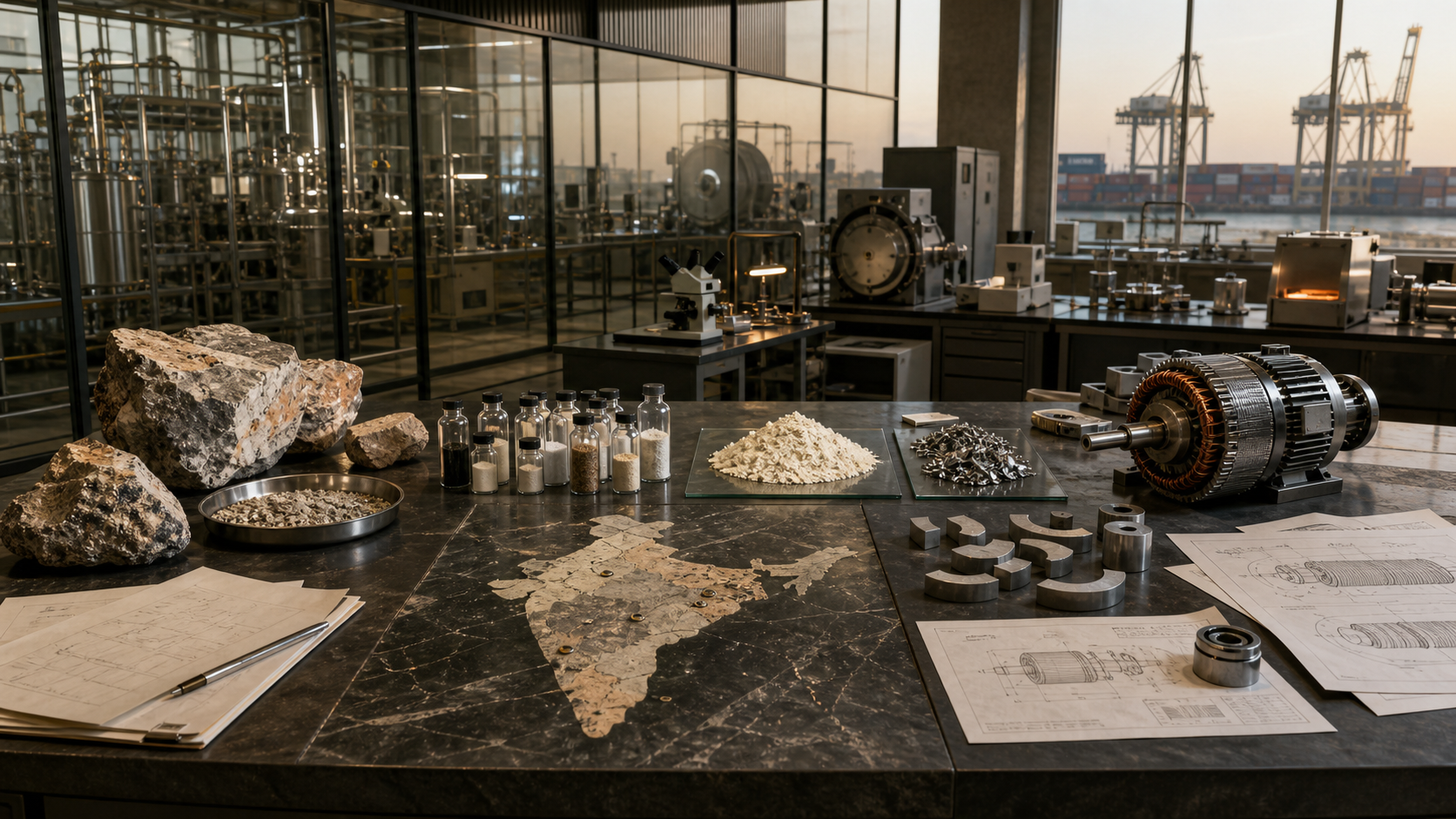
Dossier / 001 · Evidence dossier · public research edition
India and the Permanent-Magnet Chain.
Rare earths, industrial capability and the distance between resource and strategic power.Executive reading
The strategic object is not rare earth. It is a qualified chain of transformation.
India possesses rare-earth resources, separation capability and early strategic magnet capability. Yet the chain that converts resource into repeatable industrial power remains incomplete. This dossier reconstructs that chain, locates the present evidence, identifies the thresholds at which capability thins out and sets out a portfolio of strategic options without mistaking announced capacity for operating capacity.
India’s problem is not accurately described as the absence of rare earths. It is the distance between geological possession, separated material and dependable industrial function.
Chapter I / Finding register
What the public record supports.
Each finding declares whether it is documented, inferred from documented facts or unresolved in this edition.Resource does not equal magnet capability.
India has a substantial rare-earth resource base, but official records describe domestic permanent-magnet production as developing and the midstream between oxide and finished magnet as materially incomplete.
Department of Atomic Energy resource estimates; IREL Annual Report 2024–25; Ministry of Heavy Industries scheme record.Import exposure is concentrated.
For the official permanent-magnet customs categories reported by DGCI&S, China supplied between 84.8% and 90.4% of import quantity in 2024–25, depending on category.
Rajya Sabha reply published by the Press Information Bureau, August 2025. The customs categories are broader than NdFeB alone.The decisive bottleneck is downstream of separation.
India’s strategic constraint is not simply access to ore or oxide. It is the ability to convert separated oxides into metals, alloys, reproducible sintered magnets and application-qualified components at industrial scale.
IREL explicitly records a missing domestic midstream; the 2025 scheme is designed to create an integrated oxide-to-finished-magnet chain.A domestic technical base exists, but it is narrow.
IREL reports separated high-purity rare-earth compounds, industrial-scale production of selected rare-earth metals and commissioned samarium–cobalt magnet production for atomic energy, defence and space applications.
IREL Compendium on Rare Earths and Heavy Minerals; IREL Annual Report 2024–25.Policy has crossed into implementation design.
The Union approved an integrated 6,000 MTPA sintered REPM manufacturing scheme in November 2025, followed by a global tender in March 2026. The capacity is intended and tendered; it should not yet be represented as operating output.
Ministry of Heavy Industries scheme and tender records.No single intervention creates sovereignty.
Resilience requires a portfolio: domestic integration, diversified external supply, qualification infrastructure, coordinated demand, recovery, selective substitution and continuity arrangements.
Foundation synthesis of Indian public records, the IEA rare-earth value-chain assessment and the US DOE supply-chain assessment.Confidence language
The dossier separates evidence from institutional judgement.
Directly supported by a cited public record. The record may still contain scope, timing or classification limits.
A conclusion drawn from multiple documented facts. It is the Foundation’s analysis, not a quotation or official determination.
Material to the conclusion, but not answerable from the public evidence examined for this edition.
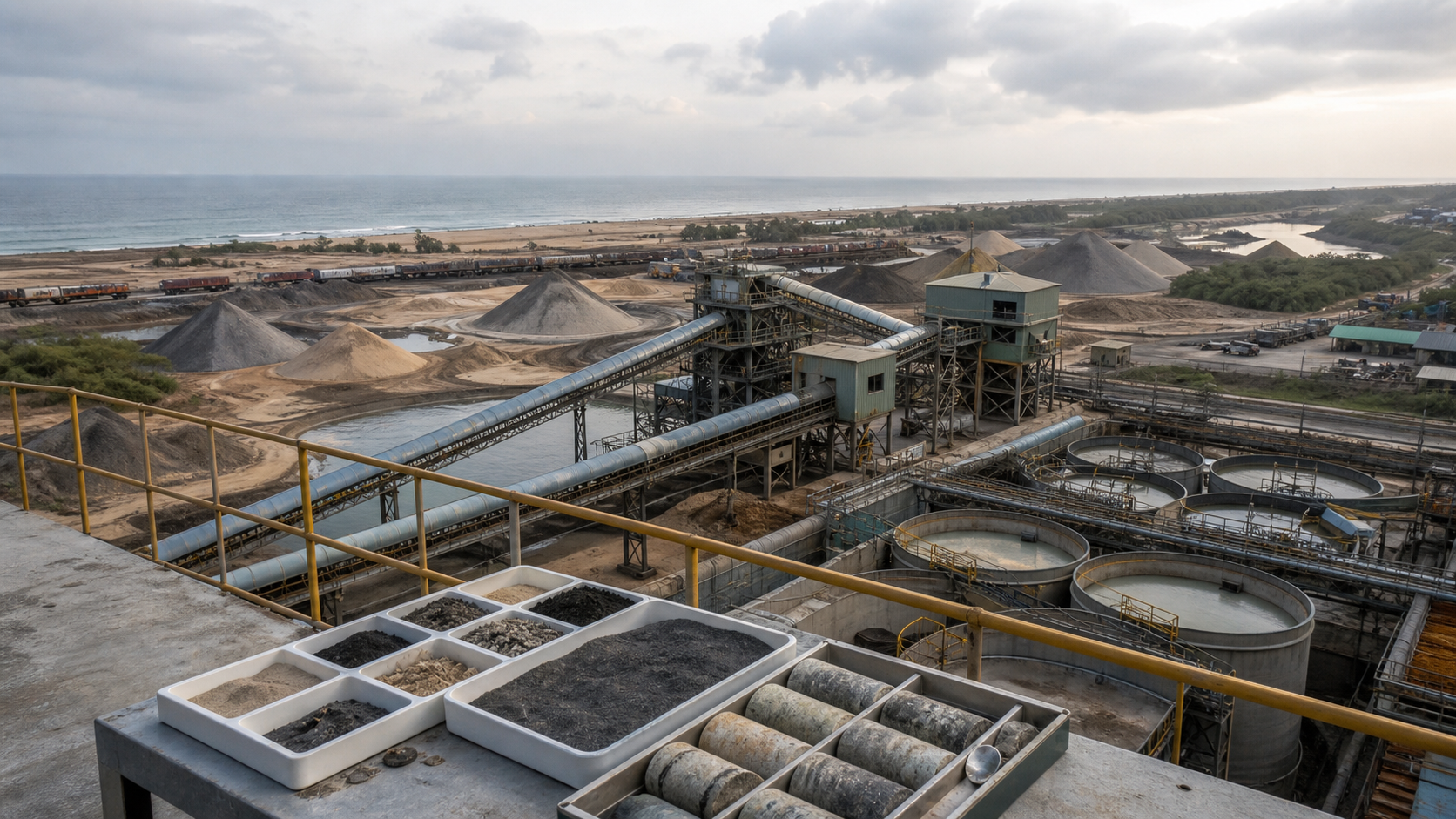
A resource enters the chain only through grade, access, extraction, separation and institutional control.
Chapter II / Chain anatomy
Nine thresholds between deposit and decision.
The table records the output of each stage, India’s documented position and the capability test that determines whether the chain can advance.Resource
Substantial documented resources, predominantly light rare earths; monazite is associated with radioactive elements and remains regulated.
Grade, mineralogy, access, environmental control and recoverability determine whether a resource can enter the chain.DocumentedConcentration & extraction
IREL operates mineral-sands and rare-earth extraction infrastructure, including OSCOM.
Lean feed, mineral co-products and radioactive association make the process multistage and institutionally specialised.DocumentedSeparation
IREL’s Rare Earths Division produces separated compounds including NdPr, samarium, dysprosium, gadolinium and yttrium forms.
Separation chemistry is technically demanding and must match downstream purity, consistency and cost requirements.DocumentedMetallisation
IREL records industrial-scale production of selected rare-earth metals at its Bhopal theme park; broad commercial depth is not established in the examined record.
Oxide must become metal with controlled purity, yield, energy use and stable process knowledge.DocumentedAlloy & powder
The public record examined does not establish a mature domestic industrial base at this stage.
Composition, microstructure, heavy-rare-earth use, atmosphere control and repeatability determine the eventual magnet grade.Open questionSintered magnet
The 2025 scheme and 2026 tender seek integrated sintered NdFeB capacity. Operating production under that scheme is not yet evidenced in this edition.
Jet milling, field alignment, pressing, sintering and thermal treatment carry high process sensitivity.DocumentedFinishing
Domestic capability is not quantified in the examined public record at grade and application level.
Machining yield, corrosion protection, magnetic orientation and traceability convert a block into a usable component.Open questionQualification
IREL reports end-use testing of SmCo magnets. Public evidence for broad NdFeB qualification capacity remains incomplete.
Automotive, wind, aerospace, defence and industrial users require different validation cycles, reliability evidence and supplier controls.Strong inferenceRecovery & continuity
IREL reports capability to recover rare earths from end-of-life magnets; national collection, disassembly and commercial-scale recovery are not established here.
Access to scrap, product design, demagnetisation, separation economics and material traceability determine recoverable value.DocumentedIndia’s starting position
Large resource figures can conceal a small field of immediately usable material.
Resource estimates describe material in the ground. They do not state recoverable NdPr, commercial oxide availability, alloy capacity, magnet yield or application qualification.
Estimated by the Department of Atomic Energy across coastal, teri/red-sand and inland-alluvial deposits.
Estimated within the documented monazite resource; this is not equivalent to recoverable NdPr or finished magnet output.
Documented in Gujarat and Rajasthan. Deposit, grade and process route remain consequential to economic conversion.
The official record distinguishes resource availability from the present state of downstream production.
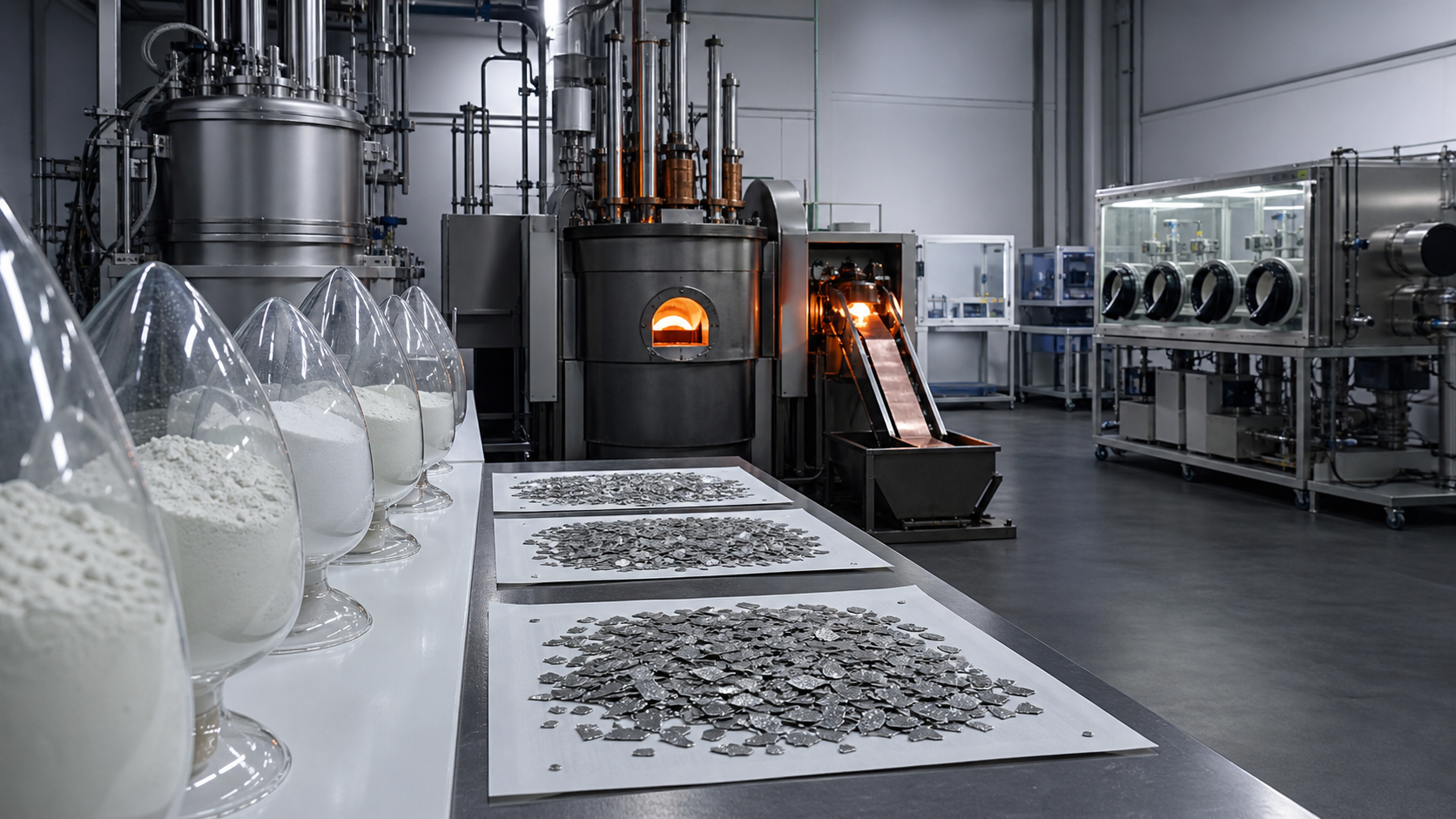
Plate II / The missing middle
Oxide is not yet metal. Metal is not yet magnet.
Purity · yield · atmosphere · alloy · microstructure · repeatabilityThe stages with the least public visibility may carry the greatest industrial consequence.
Chapter III / Trade exposure
The observed import chain is concentrated.
DGCI&S categories show dependence by value and quantity. They do not isolate chemistry, magnet grade, application or country of upstream origin.HS 85051190 covers permanent magnets “of metal”; HS 85051900 covers those “of other material”. The categories are useful exposure indicators, but they are not a clean measure of sintered NdFeB alone.
2022–23
Share sourced from China2023–24
Share sourced from China2024–25
Share sourced from ChinaSource: DGCI&S data reproduced in a Rajya Sabha reply, Ministry of Heavy Industries, August 2025. Percentages shown as published.
China’s share of global mined magnet rare earths in 2024.
China’s share of global refined magnet rare-earth output in 2024.
China’s share of global sintered permanent-magnet production in 2024.
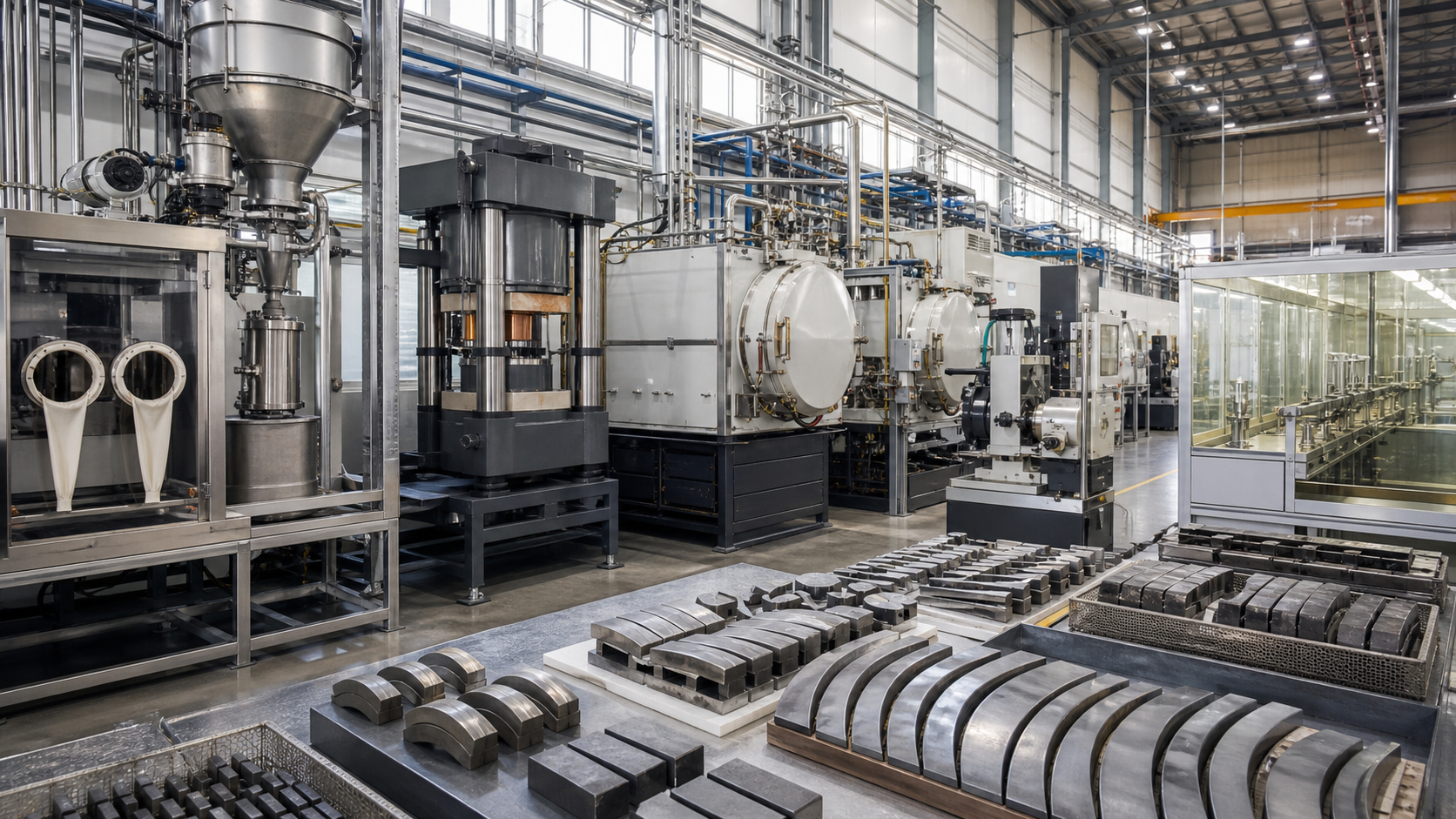
Nominal plant capacity becomes strategic capability only through yield, grade range, cost, traceability and repeatable output.
Chapter IV / Capability ledger
What must be proven before capacity can be believed.
The public record establishes direction. It does not yet answer the operating questions below.Oxide-to-metal conversion
Whether industrial capacity can supply consistent NdPr metal at the purity, cost and volume required by magnet producers.
Open questionAlloy and powder control
Whether composition, casting, milling and atmosphere control can repeatedly produce target magnetic properties.
Open questionSintered NdFeB manufacturing
Whether announced plants move from financial closure through commissioning, yield learning and stable commercial output.
Open questionApplication qualification
Whether users, laboratories and manufacturers can shorten validation without weakening safety, reliability or traceability.
Strong inferenceAnchor demand
Whether credible long-term offtake can support learning curves through periods of global price pressure.
Strong inferenceHeavy rare-earth access
How dysprosium and terbium requirements will be secured, reduced or substituted for high-temperature grades.
Open questionRecovery system
Whether collection, disassembly and magnet-to-magnet recovery can reach economic scale before large end-of-life volumes arrive.
Open questionContinuity architecture
Which stocks, contracts, alternate designs and qualification routes protect priority users during disruption.
Strong inferenceInstitutional sequence
India’s position is moving—from technical islands toward an integrated manufacturing proposition.
- 2017–18
SmCo process route
DAE reports indigenous SmCo alloy-powder development and a three-tonne-per-year permanent-magnet plant under establishment.
- June 2023
Criticality framework
The Ministry of Mines identifies rare-earth elements within India’s critical-minerals framework.
- August 2023
Mining-law reform
The MMDR amendment creates a central route for auctioning designated critical and strategic minerals.
- January 2025
National mission
The National Critical Mineral Mission establishes a wider architecture spanning exploration, overseas assets, processing, recycling, trade, technology, skills and finance.
- FY 2024–25
SmCo commissioning
IREL reports project completion and specification testing for samarium–cobalt magnets at Visakhapatnam.
- November 2025
Integrated REPM scheme
The Union approves support for 6,000 MTPA of integrated sintered rare-earth permanent-magnet capacity.
- March 2026
Global tender
The Ministry of Heavy Industries invites bids for beneficiaries, with proposed allocations of 600–1,200 MTPA each.
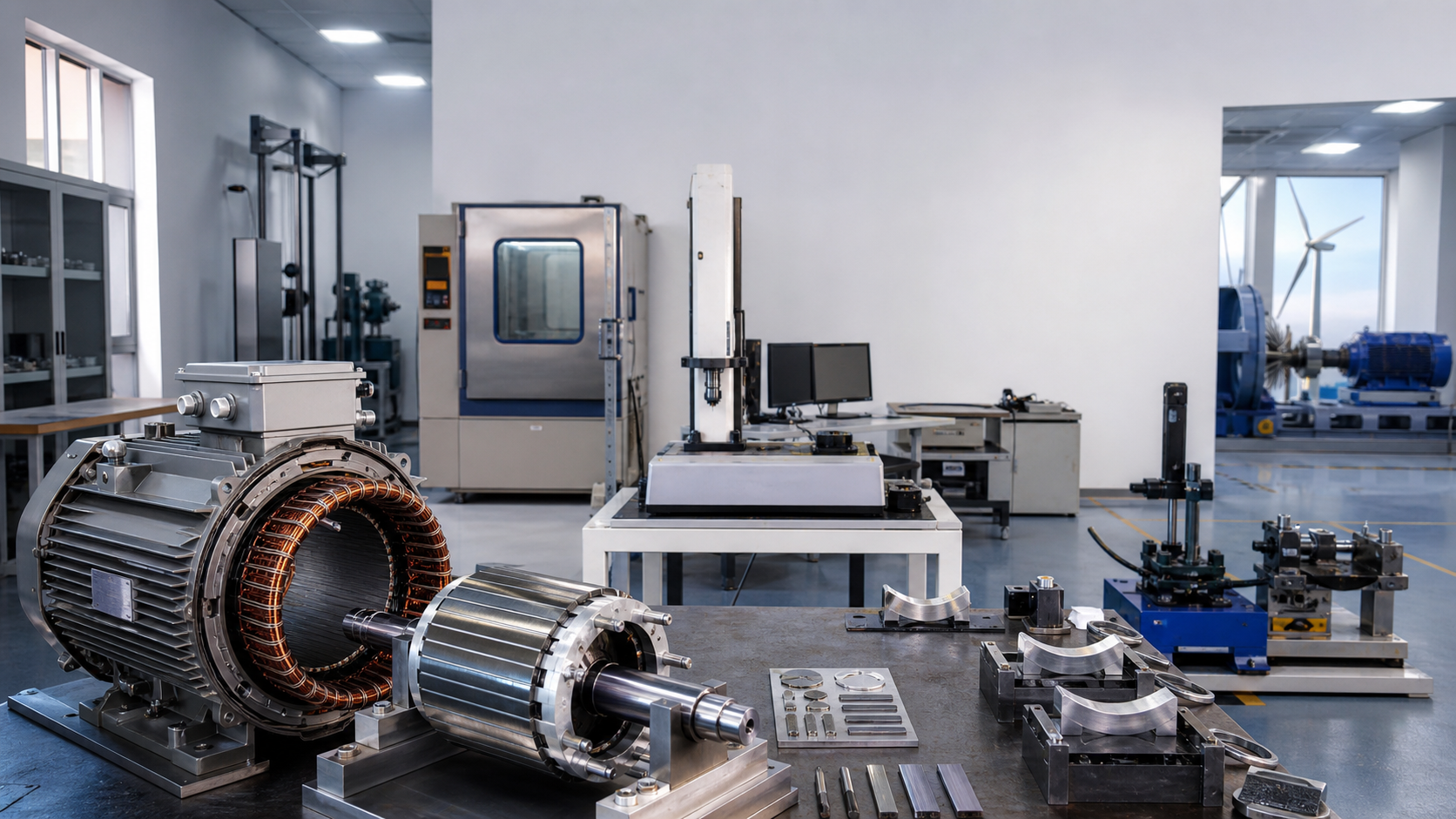
Plate IV / The qualification gate
A magnet is not strategic because it exists. It is strategic when a consequential system can trust it.
Thermal performance · corrosion · geometry · consistency · traceability · lifecycleThe user, laboratory and manufacturer must learn together; qualification is part of industrial capacity.
Demand surfaces
The same material enters different regimes of consequence.
A national strategy must distinguish commodity volume from applications in which performance, continuity and controlled provenance dominate.
Electric mobility
Traction motors can combine high power density and efficiency with demanding thermal and cost constraints.
Wind generation
Permanent-magnet generators can reduce drivetrain complexity in selected turbine architectures, especially offshore.
Industrial motion
High-efficiency motors, robotics, automation and precision motion systems place magnets inside broad productive capacity.
Electronics & data infrastructure
Miniaturised motors, actuators, drives and cooling systems create diffuse but strategically important demand.
Aerospace, defence & atomic energy
Performance at temperature, reliability and controlled supply can matter more than commodity price alone.
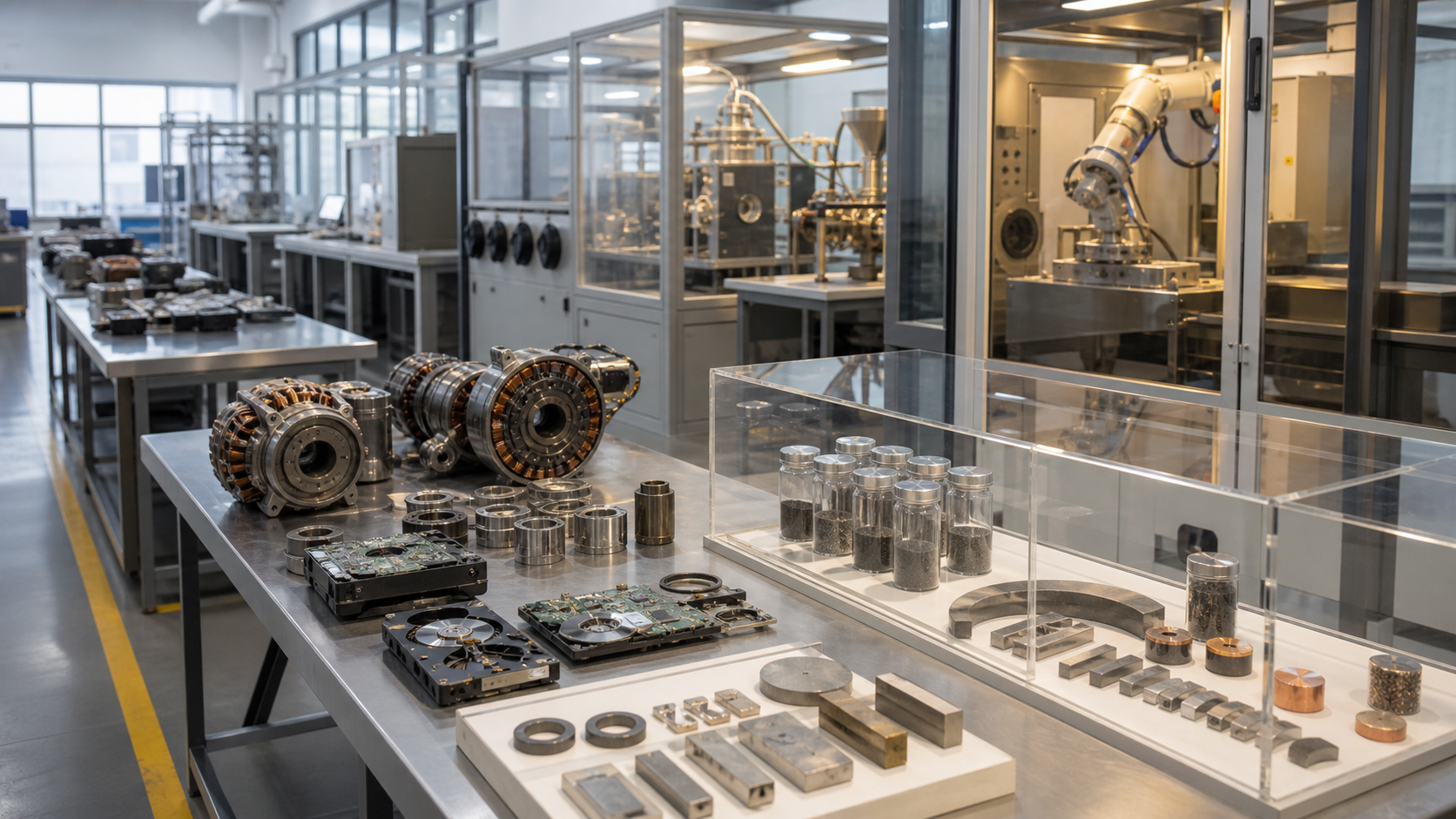
Manufacturing scrap is the near-term resource; end-of-life recovery requires collection, access, disassembly and traceability systems built in advance.
Research frontier
What the public record cannot yet answer.
These are not rhetorical gaps. They are the next evidence requirements for a decision-grade account of India’s permanent-magnet capability.
- Q/01
What operating NdPr oxide, metal and alloy capacity is available to third-party Indian magnet manufacturers at commercial terms?
- Q/02
Which magnet grades and geometries are already producible in India, at what yield and with which application approvals?
- Q/03
How much demand can credible Indian offtakers commit across automotive, wind, industrial, electronics and strategic uses?
- Q/04
Which proposed plants have secured technology, equipment, talent, finance, raw material and qualification partners?
- Q/05
What proportion of future demand requires dysprosium- or terbium-bearing high-temperature grades, and where can that exposure be reduced?
- Q/06
Which manufacturing-scrap and end-of-life streams can be captured earliest for magnet-to-magnet recovery?
Chapter VI / Method & limitations
A chain reconstruction—not an industry census.
This edition examines official Indian records from the Department of Atomic Energy, IREL, the Ministry of Mines and the Ministry of Heavy Industries, supplemented by public technical assessments from the International Energy Agency, the United States Department of Energy and the United States Geological Survey.
It does not contain confidential production data, plant visits, interviews, customs microdata, commercial pricing, audited company capacities or independent material testing. Capacity described in a policy scheme or tender is treated as intended capacity until operating evidence is available.
Trade categories are reproduced as published and are not treated as chemistry-specific NdFeB data. Resource estimates are not converted into recoverable magnet output. Where the dossier joins facts into a strategic interpretation, it labels the conclusion as a strong inference.
Source register
The evidence remains reachable.
Primary Indian records are given priority. International technical sources supply global and process context.Rare Earth Reserves in the Country
Official resource estimates and the limits created by grade, radioactivity and missing midstream industries.
Annual Report 2024–25
Primary institutional record for oxide production, missing midstream, rare-earth metals, SmCo commissioning and recovery capability.
Compendium on Rare Earths and Heavy Minerals
Process and facility record for OSCOM extraction and high-purity separated rare-earth compounds at Aluva.
Disruption in Supply of Rare Earth Magnets
DGCI&S import value and quantity shares for official permanent-magnet customs categories.
Scheme to Promote Manufacturing of Sintered Rare Earth Permanent Magnets
Official scheme architecture for an intended 6,000 MTPA integrated oxide-to-finished-magnet chain.
Global Tender for Integrated Sintered REPM Manufacturing Facilities
Tender timing, beneficiary capacity range and limited assured NdPr oxide provision.
Critical Minerals for India
Official criticality framework and identification of magnet rare-earth elements.
National Critical Mineral Mission
National architecture spanning exploration, overseas assets, recycling, trade, technology, skills and finance.
Indian Minerals Yearbook 2023 — Rare Earths
Official mineral reference for rare-earth occurrence, monazite, radioactivity and strategic applications.
Rare Earth Elements: Pathways to Secure and Diversified Supply Chains
Global chain stages, concentration, investment constraints, disruption exposure and diversification pathways.
Rare Earth Permanent Magnets: Supply Chain Deep Dive Assessment
Technical chain, manufacturing stages, recycling routes, substitution limits and industrial vulnerabilities.
Mineral Commodity Summaries 2026 — Rare Earths
Global mineral context, production and reserves record, export-control developments and substitution limits.

Nataraja Labs
Research Foundation
The chain should be seen before it is secured.
Nataraja Labs Research Foundation (2026), India and the Permanent-Magnet Chain, Dossier 001, version 1.0. Corrections and substantive evidence are invited at contact@natarajalabs.org.